


*In brief
• In Thailand, total vehicle output has edged down while production of electric vehicles (EVs) and other electrified models has risen sharply.
• The government’s long-running strategy is well supported by incentive policies that drive the momentum in EVs, as Thailand aims to become a regional hub for electrified vehicles.
• Chinese firms have a strong foothold in Thailand’s EV market, where they account for 88 percent of all EVs sold in 2025.
• EV expansion faces growing friction. Amid U.S. scrutiny over potential tariff circumvention, local industries said that foreign automakers exploit policy loopholes with cheaper imports.
• The government’s next task is to manage domestic supply chain and infrastructure pressures while upgrading and greening the production ecosystem to withstand stricter global trade and environmental scrutiny.
Thailand’s automotive sector is navigating a critical transition as production shifts toward electric and electrified vehicles. While targeted policy incentives have successfully anchored foreign assembly lines, sustaining the country's long-standing status as a regional EV manufacturing hub now presents a more complex challenge.
I/The changing domestic auto market
Thailand, long branded “the Detroit of Asia,” is experiencing a notable turn in its automotive sector from traditional vehicles towards electrified models.
In 2025, while total vehicle output edged down 0.9 percent year-on-year to 1.455 million units, production of internal combustion engine (ICE) passenger cars contracted sharply, falling 29 percent to 248,000 units, as reported by Argus in January 2026, citing data from the Federation of Thai Industries (FTI).
The expanding EV market countered the decline in conventional manufacturing. Battery-electric passenger vehicle (BEV) production more than doubled the same year, to 71,000 units, hybrid passenger EV output rose by 12 percent to over 214,000 units, and plug-in hybrid production doubled to nearly 17,300 units. However, the production of battery-powered double-car pickup trucks was merely 555 units.
On the demand side, shifting consumer preferences are clearly visible in new vehicle registrations. Annual BEV registrations climbed by nearly 53 percent year-on-year to 147,500 units, apart from the 137,600 hybrid EVs registered. However, transitional technology still dominates the active fleet. Cumulative hybrid registrations have a significant lead at 605,000 units, compared with 372,600 units of BEVs. It should be noted that the dynamics of Thailand’s EV sector are less the outcome of organic market trends than an artifact of aggressive state intervention to realize Bangkok's ambitions in the new era of EV mobility.
II/State-driven EV incentives
In May 2021, Thailand's National EV Policy Committee introduced the Zero Emission Vehicle (ZEV) framework under the 30@30 policy, which mandates that ZEVs constitute at least 30 percent of total domestic vehicle output by 2030. This is a three-phase roadmap, with Phase 1 (2021–2022) serving as an accelerator that prioritized the trial promotion of electric motorcycles alongside supporting infrastructure.
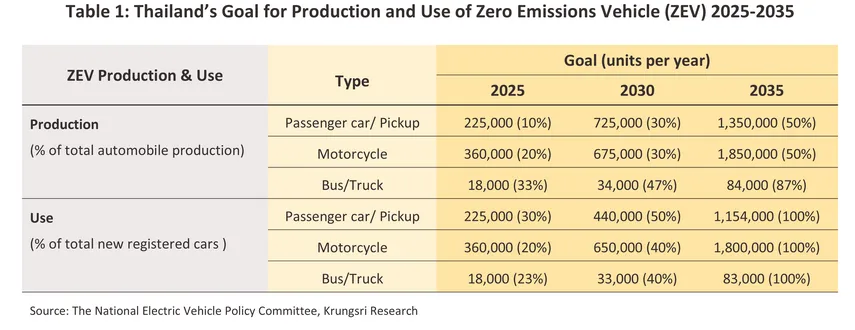
By the end of Phase 2 in 2025, passenger EVs and electric pickup trucks were to represent 10 percent of total vehicle output, or 225,000 units, with ZEVs at 30 percent of new registrations. Available figures, as noted above, put EV production in 2025 at 71,000, and 555 electric pickups. The targets rise to 30 percent for production and 50 percent for registrations by the end of Phase 3 in 2030 and, ultimately, to 50 percent and 100 percent, respectively, by 2035, as described by Krungsri Research in December 2025.
To help achieve these targets, the Thai government introduced two flagship incentive packages, EV 3.0 and EV 3.5, to drive market adoption and local production.
Credit: Krungsri Research, Industry Outlook 2026-2028: Electric Vehicle Industry, 2025
Manufacturers importing vehicles under the EV 3.0 scheme during 2022–2023 were required to offset those imports with local production within 2024–2025. The policy mandated a one-to-one production offset ratio for units imported in 2022, which increased to a 1.5:1 ratio for 2023 imports. Furthermore, while manufacturers of lower-end models were permitted to produce alternative EV variations locally, those importing premium models were required to assemble exactly the same versions domestically, to fulfill their policy obligations.
When the EV 3.0 package drove a surge in BEV registrations, the Thai government launched its EV 3.5 program (2024–2027) in January 2024. In this scheme, manufacturers importing vehicles during 2024–2025 had to offset them with local production within 2026–2027 at stricter ratios of 1:2 for 2026 and 1:3 for 2027, with premium models (priced above THB 2 million or USD 61,263) requiring exact-model domestic assembly.
However, following weaker-than-expected BEV sales in 2024, the National Electric Vehicle Policy Board (EV Board) in December of that year allowed EV 3.0 participants to defer their offset production to 2026–2027.
Then, to encourage manufacturers to expand beyond the domestic market, starting in 2025 the EV Board introduced an export incentive mechanism. Under the updated rules, every single locally produced BEV designated for export would count as 1.5 units toward fulfilling the manufacturer’s domestic offset production requirements, according to Krungsri Research. According to the Thailand Board of Investment (BOI), the EV 3.5 package underscored the government’s effort to cement Thailand as the region's prominent EV hub, aiming to bring in new players while encouraging existing investors to shift into the EV industry.
III/Chinese firms in Thailand’s EV buildout
EV models from Chinese brands have accelerated market adoption in Thailand. They made up a staggering 88 percent of all EVs sold in the country in 2025, according to BloombergNEF (BNEF).
Chinese automakers demonstrated their market dominance with a record 132,951 car bookings at the 2026 Bangkok International Motor Show, concluded in April. This was a 71 percent increase from 2025. For a second consecutive year, BYD surpassed Toyota for the top position, leading an expansion where Chinese brands occupied eight of the top 10 positions in bookings, The Nation reported in April 2026.
China’s growing role in Thailand’s EV sector is part of a wider overseas push by the former’s electric vehicle and battery companies. Years of state support for EV adoption and production, combined with manufacturing scale and fast technology upgrades, have given Chinese firms a clear cost and technical advantage over many global competitors.
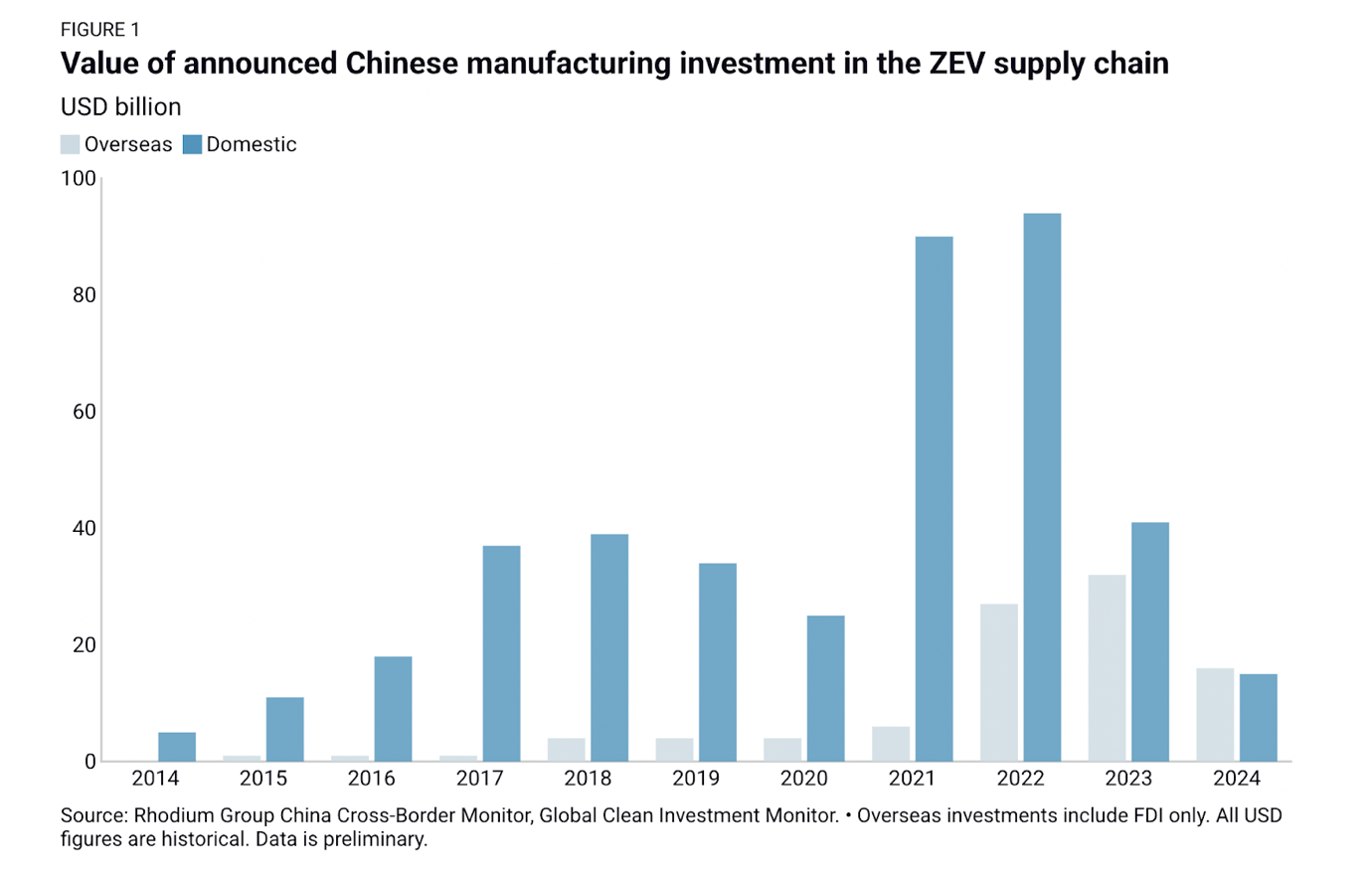
Increasingly, that advantage is moving abroad. In 2024, Chinese zero-emission vehicle firms invested more overseas than at home, a historic shift after years in which around 80 percent of investment was directed to the domestic market, according to the Rhodium Group.
Credit: Rhodium Group, The Global Investments Powering China’s EV Push, 2025
In EV manufacturing, Southeast Asia and Europe have attracted the most Chinese investment, according to the Net Zero Industrial Policy Lab at Johns Hopkins University in September 2025. Southeast Asia has become one of the first destinations for Chinese EV-makers, helped by markets that are still building out their clean energy and electric mobility ecosystems.
In Thailand, the rapid influx of Chinese investment has raised long-term sustainability concerns. The Federation of Thai Industries (FTI) warned that once the current EV 3.5 subsidy program expires in 2027, Chinese automakers may shift their strategy from local assembly to importing completely built-up (CBU) vehicles directly from China. Because operating costs in Thailand remain higher than in China, manufacturers could leverage the ASEAN–China Free Trade Agreement’s 0 percent import duty to bring in cheaper vehicles, potentially leaving local production lines vulnerable and weakening the domestic automotive supply chain, the Bangkok Post reported in June 2026.
IV/The pressure points behind Thailand’s EV buildout
The risk of cheaper imports undermining domestic production is just one of the wider challenges Thailand faces. While the government has succeeded in boosting electrified output and adoption, realizing its ambitions to establish Thailand as a regional EV manufacturing hub will depend on how it handles several underlying pressure points.
1/Domestic supply chain adaptability and strain on downstream infrastructure
The strain is felt most acutely across the local supplier network. According to a 2025 report by Kiriya Kulkolkarn, an associate professor at the Faculty of Economics of Thailand’s Thammasat University, the country’s extensive auto parts industry is built around ICE vehicles, while EVs require fewer mechanical components and more electronics, batteries, and software-linked systems. The resulting transition is already squeezing profit margins for Tier-2 and Tier-3 suppliers, many of which are small- and medium-sized enterprises lacking the capital and technical capabilities to adapt.
Thai observers see competitive pressures are sharpening as Chinese suppliers follow their automaker customers into Southeast Asia, part of the “whole-system going overseas” strategy reported by China’s state-owned Economic Information Daily in June 2026.
Even so, the transition in Thailand does not imply a total displacement of the existing industry. A February 2026 World Bank report cited by The Nation says that “more than 80 percent of auto parts sales in Thailand could continue to be used in EVs, with 58 percent of sales unaffected and 19 percent requiring only limited modification. This suggests considerable potential to preserve domestic employment while upgrading production.”
Local suppliers’ slow pace of adaptation is only one of numerous challenges Thailand must resolve in its push to become the premier regional EV manufacturing hub. The domestic commercial ecosystem faces operational bottlenecks, particularly where post-sale support and component availability are failing to meet market readiness. Echoing these constraints, the severe shortage of replacement components was classified as a major breach of buyer protections in 2025, Market Research Thailand reported. Scarce inventory has left vehicle owners stranded as long as ten months over standard collision repairs, which has driven local EV insurance premiums up by 20–25 percent. Long charging durations and the complexities of setting up home charging infrastructure continue to exert a drag on the ownership experience. There is a measurable satisfaction gap where battery electric vehicles now trail traditional ICE and hybrid vehicles in customer experience indexes, Bangkok Post reported.
2/Origin risks and trade scrutiny
A second pressure point centers on origin risks that potentially lead to trade penalties. In May 2026, a coalition of ten Thai automotive associations petitioned the government, warning that foreign brands are exploiting Thailand’s subsidy and incentive schemes for unfair gains. Because manufacturing EVs domestically costs 30 percent to 40 percent more than importing them directly from China, certain carmakers have prioritized importing CBU units under 0 percent tariff privileges over genuine local assembly. A prime example is the Chinese automaker Neta, which imported 16,300 EVs and absorbed over THB 2 billion (USD 60.7 million) in state subsidies, yet left 24,000 units of domestic compensation–production obligations unfulfilled, according to The Nation.
To counter this policy exploitation and protect domestic production, the automotive coalition urged the government to align tax incentives with strict local integration. They also called for tightening free-zone rules and linking tax privileges to the use of locally made high-value parts, such as chassis and body components. While maintaining the 40 percent local value-added threshold, they demanded a stricter calculation method to reflect real domestic value, insisting that carmakers use more parts that go into EVs as well as traditional vehicles. Most notably, the coalition demanded stronger certificate-of-origin checks with traceability down to Tier-3 suppliers to prevent the misuse of origin privileges and safeguard Thailand’s export reputation.
Such domestic anxieties and defensive proposals come at a time of intensifying trade enforcement from Washington. In early 2026, the Office of the United States Trade Representative (USTR) initiated a probe under Section 301 of the Trade Act to assess whether Thailand and other ASEAN nations serve as final assembly points for redirected Chinese production to circumvent international trade barriers. The expanding scrutiny led Chinese EV-maker BYD in March 2026 to formally deny allegations that its THB 35.9 billion (USD 1.1 billion) manufacturing base in Rayong is being used as a tariff back door, clarifying that the facility is built to serve domestic demand and markets in Europe, ASEAN, and Oceania, The Nation reported.
3/Green electricity framework
The carbon footprint of the underlying power grid poses a deep-seated challenge for Thailand’s expanding EV manufacturing base, increasingly disadvantaging export-oriented manufacturers. The Nation reported in late June 2026, quoting Natee Sithiprasasana, Chairman of the Renewable Energy Industry Group at the FTI, that Thailand’s clean energy growth has hovered at just 14–17 percent from 2020 to 2025, below the Asia-Pacific average. Renewable energy currently makes up a mere 10 percent of the national power generation mix, while fossil fuels still dominate at 70 percent of total supply — an inertia that contrasts sharply with regional competitors like Vietnam. In a fast-decarbonizing global economy, pushing the energy transition now is not only an issue of the environment but also a matter of economic survival for Thailand, Sithiprasasana said.
In fact, Bangkok has introduced several policy responses to provide verifiable green power for industrial users, as part of its efforts to accelerate its net-zero emissions target date to 2050 from 2065. Thailand has launched the Utility Green Tariff Phase 2 (UGT2), a state-administered framework tailored for large electricity users to purchase green power from specific portfolios of newly developed solar and wind projects, Bangkok Post reported. In parallel, on July 15, 2026, the National Energy Policy Council (NEPC) formally approved direct Power Purchase Agreements (Direct PPAs) through Third-Party Access (TPA) to the grid, extending the mechanism to industrial sectors needing clean power, reported The Nation.
The NEPC’s move came after mounting domestic friction over equitable access under earlier frameworks. The Nation reported in May that the FTI had warned of a systemic disparity under the current UGT system, where newly arrived foreign investors and large-scale data centers were granted priority access to the limited green capacity. Meanwhile, crucial legacy sectors, led by the automotive and component manufacturing industries that have sustained Thailand’s GDP for decades, were left waiting for affordable renewable electricity.
Existing local carbon credit instruments, moreover, such as the International Renewable Energy Certificate (I-REC), are not yet fully recognized under the European Union’s Carbon Border Adjustment Mechanism (CBAM) frameworks or aligned with Science Based Targets initiative (SBTi) accounting standards, strictly limiting their utility for emissions offsetting, The Nation reported. A cohesive, globally compliant framework, driven by fully operationalized direct PPA and TPA systems, is becoming essential as international mechanisms place tighter compliance demands on the total lifecycle emissions of Thailand’s exports, including EVs, to global markets.
Collectively, these pressure points illustrate why Thailand’s EV sector is entering a more complex phase. Attracting foreign investment, including from China, has accelerated initial development; now, to secure its own longer-term good, Thailand must capture more of the value behind that investment. To maintain its auto hub status in the EV era, it has to act decisively to upgrade and green its entire supply chain — without which Thailand’s industry will struggle to withstand the upcoming regime of stringent global trade and environmental scrutiny.
.svg)



